
Mons |
Vertical Divider
The capital of the province of Hainaut is a city with a centuries-old history. Already in the 12th century, it was fortified by Count Baldwin IV of Hainaut, and in 1295 it became the capital of the county. From the 16th century onwards, Mons was the scene of many wars and conquests. Destroyed and rebuilt, it passed from hand to hand to foreign powers. From the 16th to the 18th century, the city was occupied by Spanish, French, Austrian and Dutch troops. In the 19th century, Mons became the centre of the Borinage coal industry, and the Industrial Revolution and coal mining made it a centre of heavy industry.
|
During World War I, the city was occupied by German troops until it was liberated by the Canadian Corps in the final days of the war. In September 1944, Mons was bombed by German aircraft. Today, the city is an important university and commercial center. Casteau, a nearby village, has been home to NATO Headquarters in Europe since 1967.


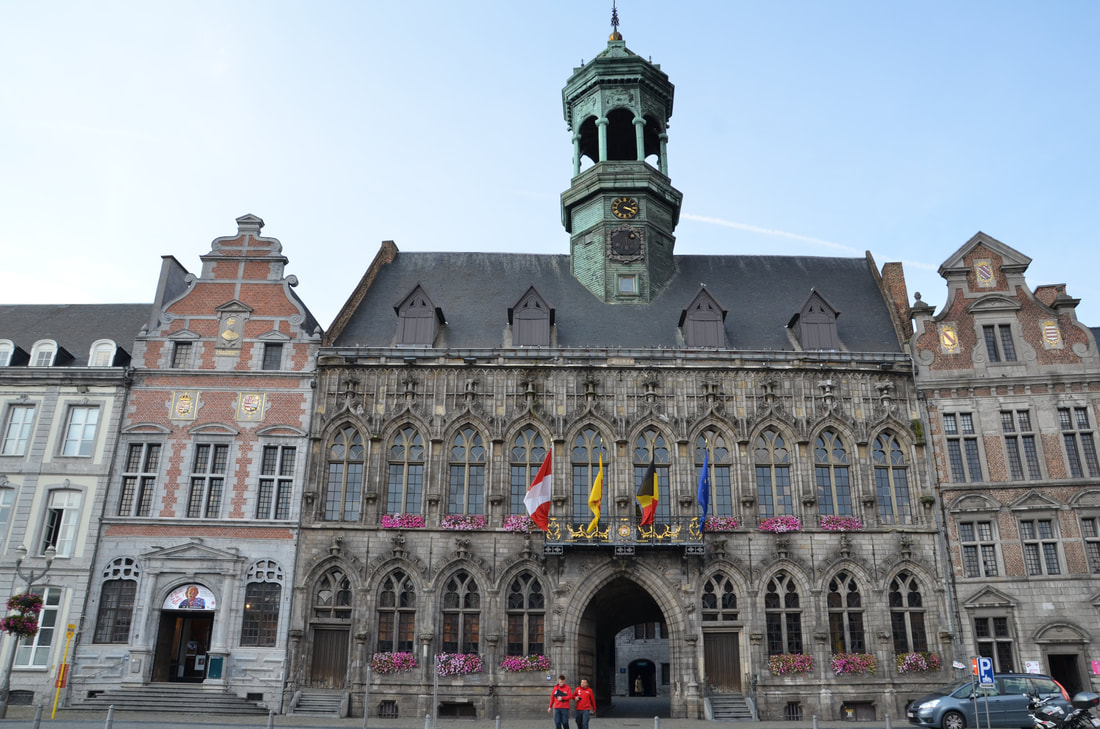
Mons Town Hall 1458-1477
The city center is located on the extensive Main Market Square, dominated by the impressive 15th-century town hall. The figurine of a monkey, the so-called Grand Garde , placed on its facade is the mascot of the residents. The building was built in the Gothic style between 1458 and 1477. The bell tower at its top was added in 1717-1718. Bronze balustrade depicting Saint George and the Dragon is a work by a French artist from 2006. It is worth visiting the very interesting courtyard of the town hall. Inside the building there is a Wedding Hall with an Italian ceiling, a Council Chamber with a marble fireplace, a Portrait Hall and a Gothic Hall, decorated in the style of the period. All these rooms can only be visited with a guide, upon prior reservation.



Belfry |
Vertical Divider
In 1999 it was added to the UNESCO World Heritage List. This is the only Baroque bell tower that has survived in Belgium to this day and was built between 1661 and 1672. Built on a hill, it offers a magnificent viewpoint overlooking the panorama of Mons. The facade of the building is made of blue stone. Inside, 365 steps lead to the top of the bell tower, where there are 49 bells that make up the carillon.
|


|
Address:
Rampe du Château 7000 Mons |
Opening hours:
Tuesday-Sunday 12.00-18.00 |
Fare:
9 euros |
Church of St. Waltrude
The construction of the present collegiate church began in 1450. The temple, built on a Latin cross plan and surrounded by 29 chapels, belonged to the canonesses of Saint Waltrude. In 1549, construction began on a tower that was never completed. The interior of the temple houses many wonderful monuments. In the treasury you can admire one of the most beautiful jewelry collections in Belgium. There are two reliquaries in the church, one containing the body of Saint Waltrude, the other her head. The oldest stained glass windows, especially the five windows in the apse, were donated to the church in 1510 by Maximilian I of Habsburg. The most interesting white stone sculptures depict Saint. Michael pushing Satan (15th century) and St. Waltrude (16th century). Attention is drawn to the golden carriage, painted and gilded in the style of Louis XVI (1780-1781), on which the reliquary of St. Waltrude.


|
Address:
Place du Chapitre 7000 Mons |
Opening hours:
Monday-Sunday 9.00-18.00 |
Fare:
church: free treasury: 4 Euro |
François Duesberg Museum
The facility, located in a historic building from the end of the 19th century, houses collections donated to the city by the Duesberg family of collectors. Presents art from the years 1775-1825. The clock collection (1795-1815), one of the most prestigious in the world, contains some truly exceptional pieces, including the extraordinary Paul et Virgine clock, commissioned in 1802 by Napoleon Bonaparte himself. Also delightful are the magnificent collection of porcelain from the best producers from Paris and Brussels, exquisite goldwork, and antique jewelry.
|
Address:
12 Square Franklin Delano Rosevelt 7000 Mons |
Opening hours:
Tuesday, Thursday, Saturday, Sunday 14.00-19.00 |
Fare:
5 euros |
La Ducasse Festival
A popular festival held on Trinity Sunday, recognized in 2005 by UNESCO as a Masterpiece of the Oral and Intangible Heritage of Humanity . The event begins with a procession during which the reliquary of St. John the Baptist is carried around the city in a gilded 18th-century carriage. Waltrude. After the procession, the Lumeçon takes place, which is a staged fight of St. George with the dragon. The celebration, which is the pride of Mons, attracts thousands of tourists to the city every year.